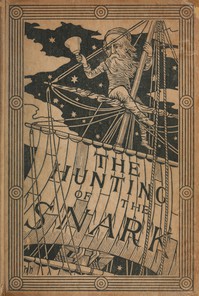
The Hunting of the Snark: An Agony in Eight Fits is typically categorised as a nonsense poem. It borrows the setting, some creatures, and eight portmanteau words from Carroll's earlier poem "Jabberwocky" in his children's novel Through the Looking-Glass.
A Connecticut Yankee in King Arthur's Court was originally titled A Yankee in King Arthur's Court. Some early editions are titled A Yankee at the Court of King Arthur.
A Tramp Abroad details a journey by the author, with his friend Harris (a character created for the book, and based on his closest friend, Joseph Twichell), through central and southern Europe. While the stated goal of the journey is to walk most of the way, the men find themselves using other forms of transport as they traverse the continent.
Although the title page is and the novel was published posthumously in 1817 with Persuasion, Northanger Abbey was completed. From a fondness of Gothic novels and an active imagination distorting her worldview, the story follows Catherine Morland, the naïve young protagonist, as she develops a better understanding of herself and the world around her.
The Posthumous Papers of the Pickwick Club (also known as The Pickwick Papers) was the first novel by English author Charles Dickens, first published in serial form. Because of his success with Sketches by Boz published, Dickens was asked by the publisher Chapman & Hall to supply descriptions to explain a series of comic "cockney sporting plates" by illustrator Robert Seymour, and to connect them into a novel.
Vanity Fair was published as a single volume in with the subtitle A Novel without a Hero. Vanity Fair is sometimes considered the "principal founder" of the Victorian domestic novel.
The Idle Thoughts of an Idle Fellow was the author’s second published book and it helped establish him as a leading English humorist. While widely considered one of Jerome’s better works, and in spite of using the same style as Three Men in a Boat, it was never as popular as the latter.
Our Mutual Friend is the fourteenth and final novel completed by English author Charles Dickens and is one of his most sophisticated works, combining savage satire with social analysis.
Martin Chuzzlewit was originally serialised between January and July. While he was writing it, Dickens told a friend that he thought it was his best work thus far, but it was one of his least popular novels, judged by sales of the monthly instalments.
Extract from Captain Stormfield's Visit to Heaven first appeared in print in Harper's Magazine in December and January, and was published in book form with some revisions. This was the last story published by Twain during his life.
Sartor Resartus: The Life and Opinions of Herr Teufelsdröckh purports to be a commentary on the thought and early life of a German philosopher called Diogenes Teufelsdröckh (which translates as 'Zeus-born Devil's-dung'), author of a tome entitled Clothes: Their Origin and Influence.
The life and opinions of Tristram Shandy, gentleman purports to be a memoir, but the titular Tristram is an effusive and digressive narrator who begins the story with his conception and does not reach a description of his birth until the third volume.
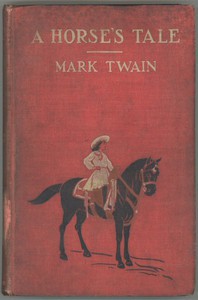
A Horse's Tale is a novel written by American author Mark Twain (Samuel Clemens), written partially in the voice of Soldier Boy, who is Buffalo Bill's favorite horse, at a fictional frontier outpost with the U.
The Comedy of Errors is one of William Shakespeare's earliest plays. The Comedy of Errors is his shortest and one of his most farcical comedies, with a major part of the humour coming from slapstick and mistaken identity, in addition to puns and word play.
The Merry Wives of Windsor or Sir John Falstaff and the Merry Wives of Windsor is a comedy by William Shakespeare first published, though believed to have been written or before. The Windsor of the play's title is a reference to the town of Windsor, the location of Windsor Castle, in Berkshire, England.
My Buried Treasure was published as a book, but is set in the 18th century, and tells a story of "buccaneers and buried gold". My Buried Treasure is considered a coming-of-age story, and is noted for its atmosphere, characters, and action.
Extracts from Adam's Diary, translated from the original ms was first published in The Niagara Book, and was collected in Twain's book My Debut as a Literary Person with Other Essays and Stories. "Extracts from Adam's Diary" was first published as a book by Harper & Brothers, with numerous illustrations by Frederick Strothmann.
Three men on the bummel was published in 1900, eleven years after his most famous work, Three Men in a Boat. The sequel brings back the three companions who figured in Three Men in a Boat, this time on a bicycle tour through Germany.
Is Shakespeare Dead? From My Autobiography explores the controversy over the authorship of the Shakespearean literary canon via satire, anecdote, and extensive quotation of contemporary authors on the subject.
The original full title was A House-Boat on the Styx: Being Some Account of the Divers Doings of the Associated Shades. A House-Boat on the Styx was first published by Harper Brothers in with illustrations by Peter Newell (24 plates).
Our American Cousin is a farce about an awkward, boorish American man named Asa Trenchard who is introduced to his aristocratic English relatives when he goes to England to claim the family estate. The play premiered with great success at Laura Keene's Theatre in New York City, with Laura Keene in the cast, the title character played by Joseph Jefferson, and Edward Askew Sothern playing Lord Dundreary.
Fenimore Cooper's Literary Offences draws on examples from The Deerslayer and The Pathfinder from Cooper's Leatherstocking Tales. The essay is characteristic of Twain's biting, derisive, and highly satirical style of literary criticism, a form he also used to deride such authors as Oliver Goldsmith, George Eliot, Jane Austen, and Robert Louis Stevenson.
Thackeray, who based the novel on the life and exploits of the Anglo-Irish rake and fortune-hunter Andrew Robinson Stoney, later reissued it under the title The Memoirs of Barry Lyndon, Esq. Barry Lyndon is narrated by Lyndon himself, who functions as a quintessentially unreliable narrator.
The Adventures of Mr. Verdant Green covers the exploits of Verdant Green, a first-year student at Oxford University. Green is an undergraduate at the fictional Brazenface College.
"Peter Bell the Third" is a satire and parody by the English Romantic poet Percy Bysshe Shelley. Peter Bell the Third was not published in The Poetical Works of Percy Bysshe Shelley.
The Way We Live Now is one of the last significant Victorian novels to have been published in monthly parts. The Way We Live Now is one of Trollope's longest, comprising 100 chapters, and is particularly rich in sub-plot.
The Blunderer is generally believed to have been first acted at Lyons, whilst Moliere and his troupe were in the provinces. In the month of November it was played for the first time in Paris, where it obtained a great and well-deserved success.
St. Patrick's Day; Or, The Scheming Lieutenant: A Farce in One Act is said to have completed by the author within two days. Sheridan wrote the two-act farce for the benefit performance of lead actor Laurence Clinch, who had so successfully played Sir Lucius O'Trigger in his previous play The Rivals.
The Consolidator; or, Memoirs of Sundry Transactions from the World in the Moon is a fictional adventure by Daniel Defoe published. The Consolidator; or, Memoirs of Sundry Transactions from the World in the Moon is a satirical novel that mixes fantasy, political satire, and social satire.
The Eustace Diamonds is considered the third of what are now called the Palliser novels, though Trollope himself didn't see it as part of the series and the characters of Plantagenet Palliser, Lady Glencora and their circle remain mostly in the background.
The Three Jovial Huntsmen (1880) was a popular British picture book illustrated by Randolph Caldecott, engraved and printed by Edmund Evans and published by George Routledge & Sons in London. The toy book, which is a variant of the folklore song The Three Huntsmen (sometimes called the Three Jolly Huntsmen), was well-received, selling tens of thousands of copies.
Candide, ou l'Optimisme ( kon-DEED or kahn-DEED, French: [kɑ̃did] ) is a French satire written by Voltaire, a philosopher of the Age of Enlightenment, first published. A young man, Candide, lives a sheltered life in an Edenic paradise, being indoctrinated with Leibnizian optimism by his mentor, Professor Pangloss.
Chapters from My Autobiography are 25 pieces of autobiographical work published by American author Mark Twain in the North American Review between September and December. Rather than following the standard form of an autobiography, they comprise a rambling gathering of anecdotes and ruminations.
The Confidence-Man: His Masquerade, first published in New York on April Fool's Day, is the ninth and final novel by American writer Herman Melville. The Confidence-Man: His Masquerade was published on the exact day of the novel's setting.
The Big Bow Mystery was originally serialised in The Star newspaper, before being published as a novel the following year. Set in London's East End, it is one of the earliest examples of the locked-room mystery genre.
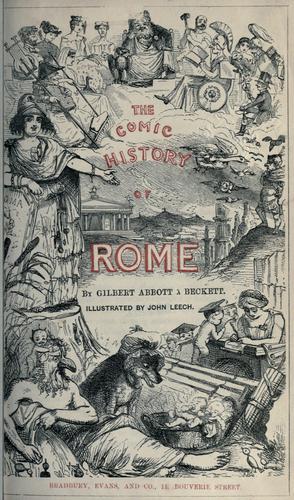
The Comic History of Rome was published by Bradbury and Evans, with text by the English humorist Gilbert Abbott à Beckett and comic illustrations by John Leech, famous for his illustrations for the novella A Christmas Carol by Charles Dickens. In his introduction, à Beckett wrote that, "The writer of this book is animated by an earnest wish to aid, as far as he is able, in the project of combining instruction with amusement.
The Old Debauchees. A Comedy premiered alongside The Covent-Garden Tragedy on 1 June at the Theatre Royal, Drury Lane, and was later revived as The Debauchees; or, The Jesuit Caught. The play recounts a Catholic priest's unsuccessful attempt to manipulate a man into seducing his own daughter.
The Heroine is a quixotic satire, in which the protagonist displays the hallmarks of "heroinism" exemplified by Germaine de Staël's novel Corinne ou l'Italie and goes through a series of Gothic adventures inspired by Ann Radcliffe's novels.
A Pickle for the Knowing Ones uses spelling and grammar that are often considered poor, and contains almost no punctuation. Dexter was a rich businessman and an eccentric, known for gaining his wealth through ill-advised but ultimately lucky investments like sending coals to Newcastle at the time of a miners' strike.
The Westminster Alice is a political parody of Lewis Carroll's two books, Alice's Adventures in Wonderland and Through the Looking-Glass. The Westminster Alice features 48 drawings by Francis Carruthers Gould, after the originals by John Tenniel.
The Hole Book stays with an accidentally-fired bullet as it travels through various scenes and objects in a town. The physical book features a literal, die-cut hole on each page, which is incorporated into the illustrations of havoc wreaked along bullet's path.
Salmagundi; or The Whim-whams and Opinions of Launcelot Langstaff, Esq. & Others, commonly referred to as Salmagundi, was a 19th-century satirical periodical created and written by American writer Washington Irving, his oldest brother William, and James Kirke Paulding.